Reading time approx 3 minutes
Let’s talk lymph because if your dog’s itchy, inflamed, or full of yeasty gunk, this system needs your attention.
Your dog’s lymphatic system is like a sewer network. Its job? To collect waste from every single cell in the body and carry it out. It deals with acids, dead cells, toxins, and general metabolic rubbish that your dog’s body doesn’t want hanging around.
The problem? The lymph system has no pump.
Unlike the blood, which has the heart to push it around, the lymph relies on movement, muscle activity, deep breathing, and hydration to move. So if a dog is sluggish, inflamed, or on a dry processed diet… guess what? The lymph gets stuck.
And when lymph gets stuck, it becomes toxic. Acidic. Hot leading to dis-ease.
That’s when you see things like:
• Raw, red skin
• Hotspots
• Gunky, yeasty ears
• Paw chewing
• Swollen glands
• And even organ damage over time
And where does all that lymph go?
To the kidneys. That’s where the real detox happens. The kidneys are the body’s filtration system, the final stop for waste removal. Their job is to take all the toxins, acids, and cellular debris collected by the lymph and eliminate them through urine.
But here’s the issue: when the kidneys become sluggish, congested, or underactive, which is all too common in dogs burdened by poor diets, chronic dehydration, toxic exposure, or a history of over-medication, the lymphatic system can’t drain efficiently.
It backs up. And when that happens, the whole body becomes a waste dump.
So if your dog is inflamed, itchy, or loaded with symptoms, it’s not about suppressing the signs; it’s about helping the body drain and clear the junk out.
From a natural hygiene perspective, many of these symptoms, like gunky eyes, waxy ears, or excessive discharge, are the body’s intelligent way of protecting itself. When acidic waste builds up in the tissues and the lymph can’t clear it fast enough, the body produces mucus to buffer and neutralise those acids. Mucus acts as a natural shield; it binds to acids and toxins, helping prevent cellular damage.
This process may not look pretty, but it’s nothing short of miraculous. The body, in its wisdom, creates these responses not to harm but to heal, to buy time, to protect, to cleanse. Rather than viewing mucus or discharge as a “problem,” we can begin to see it as part of the body’s remarkable effort to restore balance and eliminate what doesn’t belong. Support that process, and the body can do what it was always designed to do: heal.
One of the simplest ways to do that?
Hydrating fruits.
Watery, cleansing foods help thin the lymph and support kidney function, giving waste a clear path out of the body.
Why is hydration so essential? Because your dog’s body is about 70% water.
And water isn’t just a thirst-quencher, it’s the medium for every biological function: digestion, circulation, temperature regulation, detoxification, and yes, lymph flow and kidney filtration.
To maintain homeostasis, that vital balance where everything runs smoothly, your dog needs constant hydration. And not just from the water bowl.
He needs structured, living water from raw, fresh foods, just like nature intended.
When the body becomes even mildly dehydrated, lymph gets sticky, detox slows, kidneys struggle, and inflammation builds. That’s when you start seeing the signs:
itchy skin, gunky ears, hotspots, fatigue, and more.
Here are some of my favourite fruits to help get the lymph moving:
• Watermelon – deeply hydrating and super gentle
• Cucumber and Courgette – cooling, moistening, and easy to digest
• Pears – gentle on the gut and great for moisture
• Blueberries – support both the lymph and the kidneys
These fruits are loaded with structured water, enzymes, and natural astringents that help dissolve waste and pull it out through the kidneys.
And no, the sugar in fruit isn’t a problem when you’re using real, whole, raw fruits as part of a healing protocol. The real problem is the fats, meds, vaccines, and dehydrating processed food clogging up the works.
Fasting helps. When done safely, short breaks from food (even just a skipped meal or a mono-fast with hydrating fruits) give the digestive system a rest. This allows the body to shift energy toward detox, helping the lymph flow more freely and the kidneys do their job more effectively.
I go deeper into this in my blog on fasting here: https://canine-wellness-specialist.uk/2024/04/09/fasting-dogs/ if you’d like to learn when and how to do it in a way that supports healing.
 Movement helps too! gentle walks, fresh air, sunshine, and calm time outdoors all support lymph flow.
Manual Lymphatic Drainage for Dogs: Gentle Techniques You Can Try
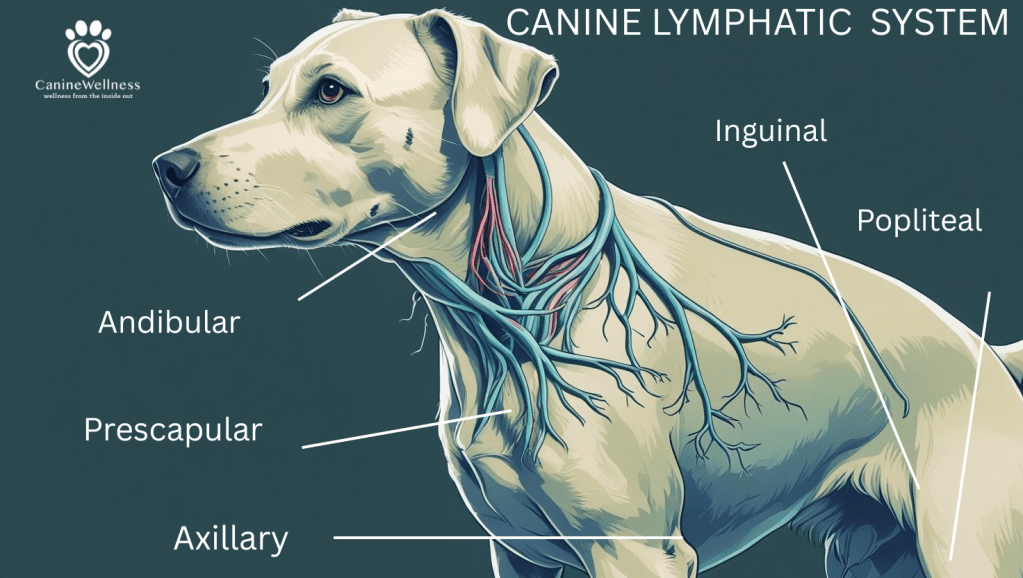
The lymph system lives just under the skin, and that’s why light, intentional touch can go a long way. You don’t need deep pressure or anything forceful. In fact, lymph responds best to a soft, sweeping rhythm that mimics the natural flow of fluid in the body.
Here are some simple techniques to support lymph movement in your dog:
1. Start with Calm Connection
Make sure your dog is relaxed before you begin. Choose a quiet, safe space and start with a few gentle strokes along their back or chest to help them settle in. Calm breathing and slow movements will help both of you.
2. Neck & Chest Circles
This area is rich in lymph nodes. Use flat fingers and make light, circular motions just above the collarbone and along the side of the neck, think of it as waking up the drainage points. Do this for about 30 seconds on each side.
3. Behind the Ears & Jawline
Using gentle pressure, stroke from behind the ears down the neck toward the chest. This helps move lymph from the head and face, especially helpful for dogs with gunky ears or eye discharge.
4. Under the Front Legs (Armpits)
There are large lymph nodes under the forelimbs. Gently lift the leg and use soft fingers to sweep the area inward toward the chest. Always keep the motion flowing toward the heart.
5. Back Legs & Groin
Use the same soft sweeping motion along the inner thigh, moving upwards toward the belly. This can be especially supportive for dogs with inflamed paws or back-end swelling (anal glands). You can read more about anal glands and their function here: https://canine-wellness-specialist.uk/2025/04/23/anal-glands-unpacked-why-dogs-struggle-how-to-fix-it-the-natural-way/
6. Finish with Long Sweeps
Wrap up the session by using long, slow strokes from the shoulders down to the paws and from the hips to the feet. This promotes overall circulation and leaves your dog feeling relaxed and grounded.
You can also use a soft dry brush designed for pets. Many dogs find this incredibly soothing, and it’s a gentle, relaxing way to stimulate lymph flow and improve circulation.
⏱️ How Often?
You can apply these techniques a few times a week, or even daily if your dog is experiencing inflammation or swollen glands, ‘allergies’, or detox symptoms. Each session only needs to last 5–10 minutes.
If you’re unsure or want to go deeper, you can consult a certified canine massage therapist or practitioners with experience in Manual Lymphatic Drainage (MLD) who are trained in working with animals. These professionals can offer guidance tailored to your dog’s individual needs and ensure you’re using techniques safely and effectively.
A Few Cautions:
- Don’t massage over swollen or painful areas unless guided by a professional.
- If your dog resists, stop! this should always feel soothing, not stressful.
- Avoid deep pressure; lymph vessels are fragile and respond best to feather-light touch.
So, if your dog’s lymph is stagnant and their kidneys are blocked, the waste has nowhere to go and the body gets overwhelmed.
 Supporting detox is about getting things moving again not forcing, not suppressing. Let the body clear itself out.
It starts with real food, a low-fat, species-appropriate raw diet of meat, bone, and offal supported by hydrating, water-rich fruits to get things flowing. A break from the junk.
And it ends with healing from the inside out.
Thank you for reading,
Teresa x
💬 Let’s Work Together
If your dog is showing signs of toxic overload, itchy skin, gunky ears, hotspots, swollen glands, don’t wait for it to get worse.
I offer gentle, natural support to help dogs detox safely using real food and holistic guidance tailored to your dog’s unique needs.
Get in touch here https://canine-wellness-specialist.uk/contact/
 Canine Wellness Specialist